“Across the world, data-centre operators are under pressure to deliver more capacity, faster. Yet many established facilities already contain opportunities to release additional MW through carefully engineered upgrades to generation, power, cooling and the data hall.
XPM Density was created to turn that opportunity into a secure, deliverable programme.
We work alongside your operations team, engineering leadership and existing consultants. We establish the numbers, engineer the solution, develop the CAPEX and lifecycle strategy, manufacture and procure the required infrastructure, and progressively retrofit, integrate and commission the facility.
The first decision is simple.
Give us 90 days. Let us build the technical, commercial and operational case. Then your board decides whether the opportunity justifies proceeding.
From Virginia to Dallas, Dublin to London, Frankfurt to Helsinki, Paris to Madrid, Zaragoza to Milan, Dubai to Riyadh, Singapore to Jakarta — XPM brings the same mission-critical approach to every facility.
If there is another 5 MW, 10 MW or more within your existing asset, let's establish what it takes to release it.”
Harley Stapleton
CEO | XPM
FIND. UNLOCK. DELIVER.
START YOUR 90-DAY XPM DENSITY STUDY → xpm@xpm.partners
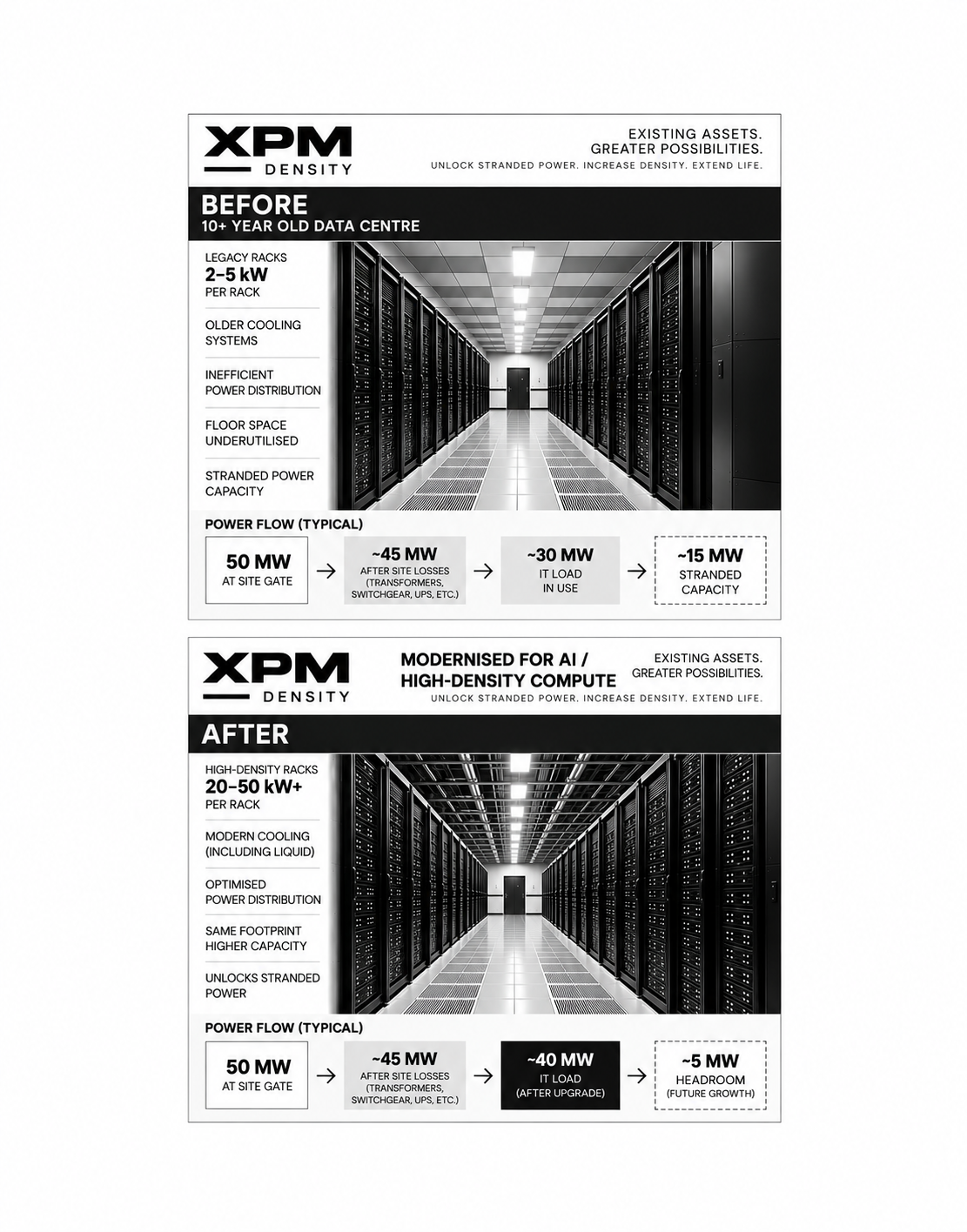
From Capacity Opportunity to Secure Delivery
Experienced data-centre operators understand their assets, their constraints and their customers.
The challenge is different: how do you convert an identified capacity opportunity into additional live IT MW without compromising the resilience of the operating facility?
XPM Density provides the specialist A–Z engineering and delivery capability to answer that question and then, where the business case supports it, deliver the solution.
Start With a 90-Day Critical Review
XPM works alongside the client's engineering and operations teams, existing consultants, OEMs and specialist contractors to develop a complete technical and commercial assessment of the opportunity.
We independently test the assumptions and work the numbers across the entire infrastructure chain — utility capacity, generators, transformers, switchgear, UPS, batteries, distribution, chillers, heat rejection, controls and the data halls.
This is not XPM working in isolation.
The people operating the facility are central to the process. Their operational knowledge is combined with XPM's specialist engineering, manufacturing, commissioning and delivery experience to establish what can realistically be achieved within a live mission-critical environment.
One Integrated Business Case
At the end of the 90 days, the client receives a board-level investment and delivery pack establishing:
Additional IT MW that can be securely delivered.
CAPEX and lifecycle offset, including planned replacement of generators, chillers, UPS, switchgear and other ageing assets.
Revenue potential created by the additional sellable capacity.
Engineering strategy required to unlock the capacity.
Risk and resilience assessment including redundancy, operational exposure and customer impact.
Manufacturing and procurement strategy for the major equipment and modular packages.
Phased implementation programme showing how the facility can be progressively upgraded while remaining operational.
Testing and commissioning strategy demonstrating how each stage is validated before additional capacity is released.
The board therefore has the technical, commercial and operational information required to make an informed investment decision.
From Study to A–Z Delivery
If the business case is approved, XPM can remain with the programme from engineering through to live operation.
Design → Engineer → Procure → Manufacture → Factory Test → Deliver → Install → Integrate → Commission → Prove
We coordinate the OEM equipment, package and manufacture the required infrastructure, work with the client's existing consultants and carefully sequence installation with the operations team.
The retrofit is undertaken progressively, system by system and capacity block by capacity block.
No additional MW is treated as available simply because new equipment has been installed. The infrastructure is tested, commissioned and proven through the required operating and failure scenarios before capacity is released.
More MW. Without Compromising What Already Works.
The objective is not simply to increase density.
It is to optimise the complete asset, align upgrades with existing lifecycle investment and convert available infrastructure potential into secure, revenue-producing IT capacity.
For an operator considering whether an existing facility could support another 5 MW, 10 MW or more, the first commitment is deliberately limited:
Undertake the study. Establish the engineering, risk, CAPEX and revenue case. Then decide whether to proceed.
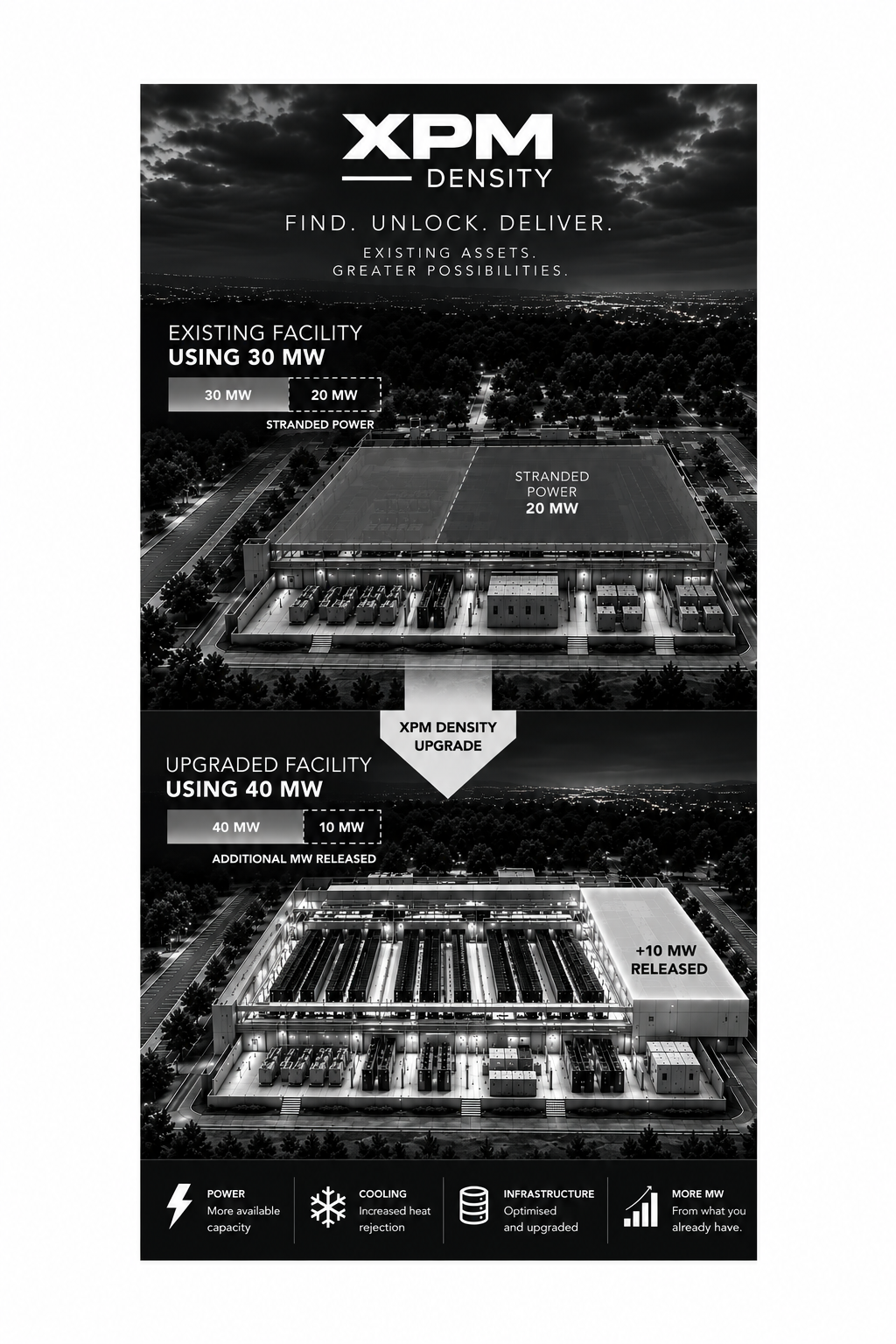
Unlock the MW Already Inside the Asset
A 10–15-year-old data centre may still be a highly valuable asset, but its original infrastructure was designed for a very different generation of IT load.
The facility may have substantial power available at the site boundary while limitations in generators, UPS systems, switchgear, cooling, distribution or the data halls themselves prevent all of that capacity reaching the IT load.
That creates stranded capacity.
And in today's capacity-constrained market, nobody wants to own a data centre capable of delivering another 5 MW or 10 MW and leave that potential unused.
Optimise the Entire Facility
XPM Density reviews the data centre as one integrated system — from the incoming utility supply through generators, transformers, switchgear, UPS, batteries and busway, across the cooling infrastructure and ultimately through to the rack.
We identify the constraint that prevents the next MW from being delivered.
The answer may involve increasing generator capacity, replacing ageing gensets, modifying redundancy philosophy, upgrading switchgear or UPS systems, increasing cooling and heat-rejection capacity, introducing liquid cooling, or converting existing halls for higher-density compute.
The objective is not to replace everything.
It is to determine the minimum intervention required to safely unlock the maximum additional capacity.
Use the Lifecycle to Fund the Upgrade
This becomes particularly compelling in facilities approaching 10–15 years of operation.
Generators, UPS systems, batteries, chillers, controls, switchgear and other critical infrastructure already have maintenance, refurbishment and replacement strategies within the owner's lifecycle programme.
Rather than replacing ageing equipment on a like-for-like basis, XPM evaluates whether that planned lifecycle expenditure can become part of a wider capacity upgrade.
A planned generator replacement can become a higher-capacity generation strategy.
A chiller replacement can become increased heat-rejection capacity.
A UPS refresh can improve efficiency while supporting additional IT load.
A data-hall refurbishment can introduce higher-density racks and liquid cooling.
The ambition is to make the capacity upgrade as lifecycle-cost-neutral as practicable — redirecting expenditure that would already have been required toward infrastructure capable of supporting the next generation of the facility.
Existing Asset. More MW.
The result can be significantly more valuable than a conventional lifecycle replacement programme.
Instead of spending capital simply to maintain yesterday's capacity, the owner has the opportunity to extend asset life, increase usable MW, support higher-density AI workloads and improve the commercial productivity of the existing facility.
Don't just replace ageing infrastructure. Use the replacement cycle to unlock the next MW.